
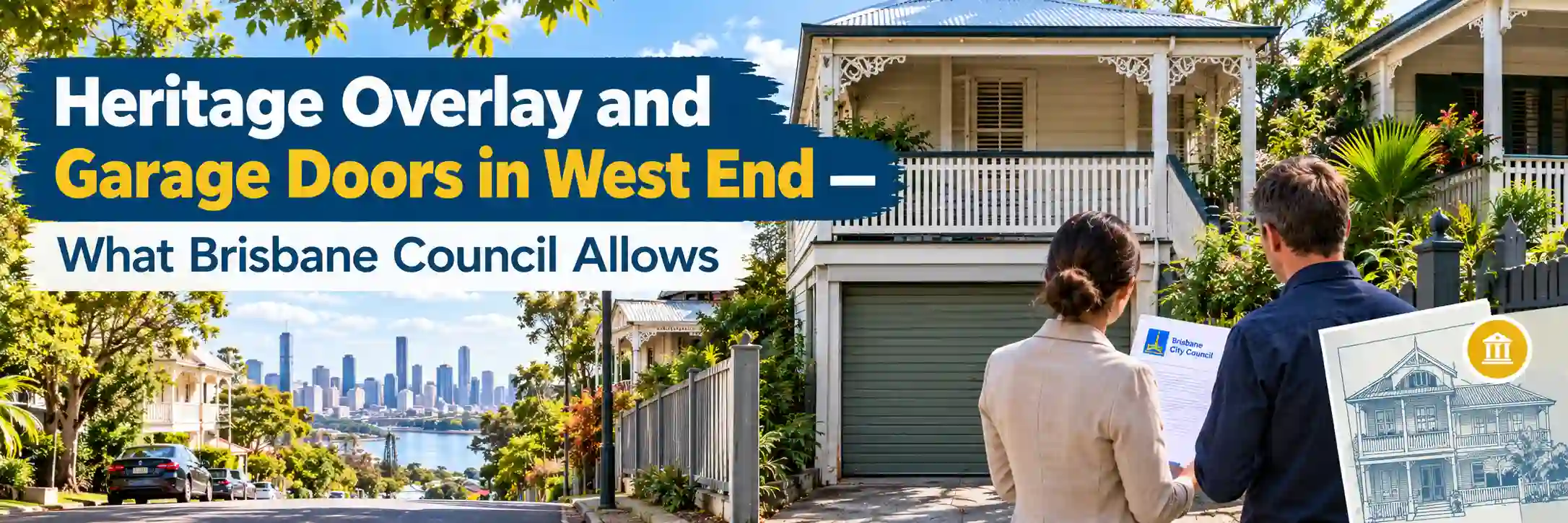
Heritage overlay and garage doors in West End is the most specifically Brisbane-heritage topic in this guide series, and the most important planning knowledge that any West End homeowner needs before making any decision about their garage door beyond a straight like-for-like repair. West End is listed on the Brisbane Heritage Register and is one of Brisbane’s most extensively protected character residential suburbs under the Brisbane City Plan 2014. The Character Residential zone, the Development Control Plan designations that appear throughout the suburb’s planning record, and the Brisbane City Council’s heritage citations for individual properties together create a planning framework that determines what garage door work can proceed without planning assessment and what requires a Development Application to Brisbane City Council before any product is ordered.
Heritage overlay and garage doors in West End addresses this framework specifically — not in general terms for Victorian suburbs or NSW heritage areas, but for the West End context under Queensland’s planning legislation and the Brisbane City Plan 2014.
The Brisbane City Plan 2014 character house code
Heritage overlay and garage doors in West End operates under the Brisbane City Plan 2014’s Character Residential zone provisions and the character house code that applies to pre-1947 buildings in the zone. West End’s housing stock is predominantly pre-1947 character homes — the Victorian-era Queenslanders, Edwardian cottages, and interwar workers’ houses that the suburb’s residents know as the character fabric of their inner-city neighbourhood.
Under the Brisbane City Plan 2014, works on a pre-1947 character home in the Character Residential zone are assessed against the character house code if they are visible from the street or from a public place. The relevant principle: if the proposed garage door work changes the external appearance of the home in a way that is visible from the street, it requires assessment under the character house code. If it does not change the external appearance, it proceeds without planning assessment.
The character house code assessment for a garage door evaluates whether the proposed door respects the traditional character of the building and the street. The Brisbane City Council’s character house code guidance for garage doors identifies several dimensions of character compatibility:
- Materials — timber or materials that resemble timber are preferred for character homes, as they relate to the original timber construction of Queenslander and cottage homes. Corrugated metal is appropriate for traditional character homes where corrugated metal was historically used in outbuildings. Contemporary steel and aluminium panel doors are generally less appropriate for street-visible installations on character homes.
- Colours — colours drawn from a heritage palette appropriate to the specific home’s period and style. A Victorian-era Queenslander from the 1870-1890 period would typically suit deep tones — deep greens, rich creams, or heritage colours from the period’s palette.
- Profile — a door profile that relates to the traditional character of the home. A simple vertically-boarded timber door is the most character-appropriate profile for a West End Queenslander under-house garage. Contemporary raised-panel or ribbed steel profiles introduce a visual language that is inconsistent with the character of a pre-1900 home.
- Automation visibility — a motor unit mounted externally on the face of a character home garage or visible from the street in a prominent position may require assessment of its visual impact. Tubular motors inside roller door drums, or motors installed in positions within the garage where they are not visible from the street, are the character-sensitive automation choice.
What does and does not require a Development Application in West End
Heritage overlay and garage doors in West End: the practical assessment of what requires a Brisbane City Council Development Application:
No DA required — like-for-like repairs and replacements that do not change the door’s external appearance:
- Replacing a failed spring, cable, motor, or other mechanical component with an equivalent specification without changing the door itself.
- Replacing a door whose external appearance is identical to the door being replaced — same material, same colour, same profile, same dimensions.
- Repainting an existing timber door in the same colour or in a colour within the heritage palette of the specific home’s period.
- DA required — changes that alter the external appearance of the garage door or opening:
- Replacing an existing timber door with a steel or aluminium alternative — a change from a character-appropriate material to a contemporary one.
- Changing the door profile — replacing a vertically-boarded timber door with a raised-panel or ribbed steel door.
- Widening or altering the garage opening dimensions.
- Installing a new garage door in an opening that did not previously have one.
- Adding external motor hardware or a drive rail that is visible from the street on a character home.
The Brisbane City Council heritage approval process for West End
Heritage overlay and garage doors in West End where a Development Application is required follows the Brisbane City Council’s code-assessable development application process. A DA for a minor building works item — including a new garage door on a character home — is typically assessed under the character house code without referral to the state heritage authority, because West End’s heritage significance is primarily a local heritage matter under the Brisbane Heritage Register rather than a state heritage matter under the Queensland Heritage Register. Properties individually listed on the Queensland Heritage Register (state level) may require referral to the Queensland Office of the Chief Executive (Heritage) alongside the Brisbane City Council assessment.
Before lodging a DA for a new garage door on a West End character property, the homeowner should:
Confirm whether the property is on the Brisbane Heritage Register (local), the Queensland Heritage Register (state), or both, as this determines the assessment pathway and referral requirements.
Consult with Brisbane City Council’s development assessment team via a pre-lodgement meeting to confirm the character house code requirements for the specific property before selecting a door product.
Prepare photographs of the existing garage door and the home’s facade, a description of the proposed replacement door including material, profile, and colour, and any manufacturer documentation for the proposed product.
Engage a Brisbane-based heritage architect or building professional experienced with the Brisbane City Plan 2014 character house code if the proposed works are complex or if there is uncertainty about the character assessment outcome.
Heritage-appropriate garage door options for West End
Heritage overlay and garage doors in West End: the door options that are most likely to satisfy the character house code assessment for a West End Queenslander or character cottage:
- Timber vertically-boarded doors — the most character-authentic option for a Queenslander under-house garage. Vertical timber boarding painted in a period-appropriate colour is the door style that most directly relates to the traditional fabric of a West End pre-1900 character home.
- Timber-composite panel doors in heritage profiles — for homeowners who want the character appearance of a timber door with improved dimensional stability in Brisbane’s humidity, timber-composite panel doors using materials that maintain timber appearance while resisting the check cracking and paint failure that solid timber develops in subtropical humidity are worth discussing with a Brisbane character home specialist.
- Simple roller doors in heritage colours inside under-house enclosures — for under-house garage openings where the roller door is recessed within the under-house space and not prominently visible from the street, a roller door in a simple profile and heritage-appropriate colour may be acceptable as a character-compatible option under the character house code, particularly if the under-house enclosure itself is not a prominent feature of the street-facing facade.
When a heritage advisor adds value in West End
Heritage overlay and garage doors in West End for any installation that involves a DA, a property individually listed on the Brisbane or Queensland Heritage Register, or any situation where the character compatibility of the proposed door is uncertain should involve a heritage advisor alongside the garage door supplier. A Brisbane inner-city heritage architect who is familiar with the Brisbane City Plan 2014 character house code, the Brisbane Heritage Register’s local heritage criteria, and the specific character of West End’s residential streets will provide a pre-DA assessment that identifies the most likely acceptable outcome before any product is ordered. This upfront professional advice is the investment that avoids the cost and delay of lodging a DA for a door that is subsequently found to be non-compliant with the character house code.
Conclusion
Heritage overlay and garage doors in West End is the most complex planning topic in this guide series, because West End is Brisbane’s most heritage-protected inner residential suburb and the Brisbane City Plan 2014’s character house code is the planning instrument that determines what is acceptable for every change to the external appearance of West End’s pre-1947 character homes. Like-for-like repairs proceed without planning assessment. Changes to door material, profile, or colour on a character home visible from the street require a Development Application assessed under the character house code.
Pre-lodgement consultation with Brisbane City Council, confirmation of the property’s heritage register status, and the involvement of a Brisbane heritage advisor for complex or uncertain situations are the steps that produce the right outcome in a suburb whose architectural heritage is among the most significant in Brisbane.